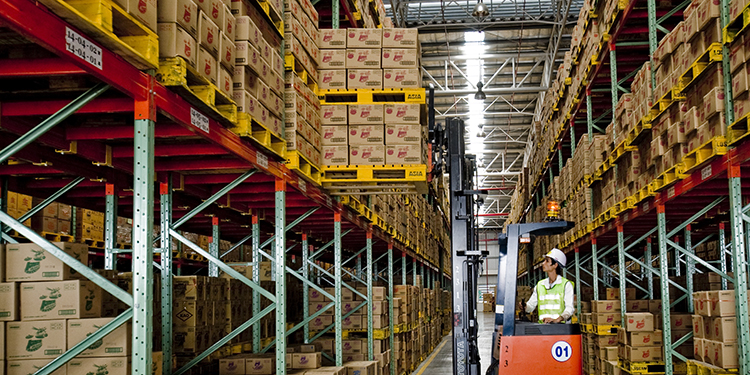
As warehouses accelerate toward automation, rack for automation is becoming a critical factor in system performance, safety, and long-term flexibility. At MODEX 2026, the Rack Manufacturers Institute (RMI) detailed what engineers, operators, and decision-makers need to understand as they plan for increasingly automated environments.
The session, entitled “Pallet Racking Systems and Design for an Automated Future,” featured representatives of three RMI member companies. They were:
- Tommy Sinclair, CEO of Engineered Products
- Rob Kafka, Automation Account Executive, Interlake Mecalux
- Dan Middendorf, Sales Support Manager at Nedcon
The trio explored how traditional rack principles evolve in automated systems and why getting automated rack design right from the start is essential.

Rack for Automation Starts with Strong Fundamentals
Sinclair opened the session by grounding the conversation in core rack principles. He emphasized that even highly automated facilities still rely on conventional systems.
“Often in an automated facility, not the entire facility is automated,” Sinclair explained. “You continue to have conventional rack systems that support the front end, back end, or operate in conjunction with automation.”
That reality makes foundational knowledge critical. Sinclair stressed that understanding conventional pallet rack behavior helps inform better rack design for automation, particularly when systems must integrate seamlessly.
“There are things that are different when you’re looking at design considerations for a conventional-based system versus automated,” he said. “Understanding those differences informs how we design racking for automation.”
To that end, Sinclair walked session attendees through a high-level overview of several different types of industrial storage rack. These included selective rack, double-deep selective rack, pushback rack, drive-in/drive-through rack, and more. He also explained semi-automated rack shuttle systems as one of the first steps toward automated storage and retrieval.
Transitioning to Rack for Automation: A Data-Driven, Cultural Shift
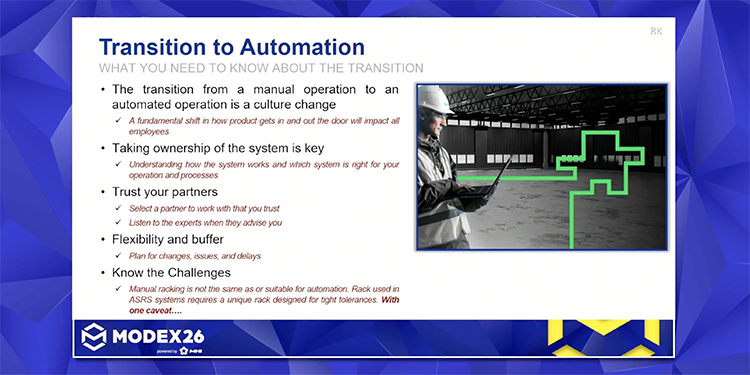
Kafka framed the move from traditional racking to automation as a fundamental operational transformation.
“When transitioning from standard rack to automation, what we’re really talking about here is a shift in how a facility operates.” That shift impacts everything from product flow to decision-making, requiring organizations to rethink processes, roles, and responsibilities.
Kafka emphasized that automation is as much a cultural change as a capital investment. “The transition from a manual to an automated operation is a cultural shift as much as an operational one,” he explained. “How the product flows, who touches it, and how decisions are made all change.” To support that shift, companies must take ownership of the system, committing not only to the upfront investment but also to ongoing training and operational discipline.
“The most important starting point is data, not equipment,” continued Kafka. “A good partner is data first, solution second.” Rather than forcing a preselected solution, the right approach is to analyze operational data, identify constraints, and then determine the best-fit automation strategy.
Kafka also highlighted what automation delivers: precision, consistency, and control. By replacing human variability with system-driven consistency, operations can achieve higher throughput, improved accuracy, and reduced product damage. In fact, he noted that minimizing human interaction can significantly reduce shrink and returns while improving customer satisfaction.
However, those benefits come with important requirements. Automated systems demand load consistency, tighter tolerances, and often reengineered rack structures. “In most cases, manual racks need to be reinstalled or replaced entirely due to the precision required for sensors and automated movement,” Kafka cautioned.
Ultimately, he positioned automation as a strategic trade-off. “Automation gives you consistency, density, throughput, but requires capital, planning, and discipline,” he said. The key question isn’t whether to automate, but when and how.
Automation Changes Rack Requirements
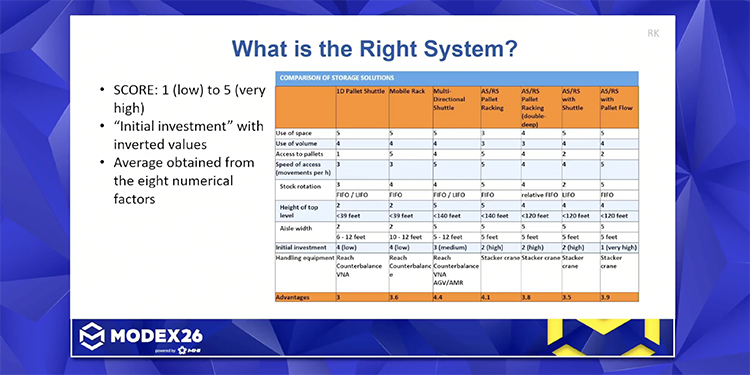
Middendorf focused on how automation is reshaping pallet rack system design, and why those decisions must start with the load itself.
From a rack manufacturer’s perspective, he emphasized that pallet type is a foundational input. “The details on the pallet type you are using in your system directly influence the style of rack configuration and automation for your system,” he said. “Specifically, Euro pallets and standard U.S. pallets (GMA or CHEP) require different support and handling.”
Middendorf then outlined several automated storage approaches, each with trade-offs in density, selectivity, throughput, and cost. Traditional stacker crane systems remain a baseline, offering strong selectivity for varied stock keeping units (SKUs).
As facilities grow taller, he pointed to the shift toward rack-supported structures. These systems can improve space utilization by eliminating lost pallet positions due to building columns. However, they require more advanced engineering and environmental design considerations.
He also emphasized the growing importance of mini-load and small goods automation, where higher speeds and lighter loads demand precision rack systems. “The mini-load systems are typically higher tolerance rack systems, and the systems go much, much faster,” he explained. Emerging technologies like autonomous mobile robots (AMRs) are adding even more flexibility, particularly for small goods storage.
Across all system types, Middendorf stressed the importance of considering automation strategy and rack design together. The right solution depends on balancing storage density, throughput, SKU variability, and long-term flexibility—while ensuring the rack system can support the demands of automation.
Learn More About Rack for Automation
As automation continues to reshape material handling, understanding rack design for automation is essential for building safe, efficient, and scalable systems.
To learn more, explore RMI’s publications, standards, and educational content at mhi.org/rmi. These resources help rack owners stay informed on best practices that support the next generation of warehouse design. Additionally, a recording of the education session is available for viewing here.