Engineers design every pallet rack system for the worst-case scenario. As the Rack Manufacturers Institute’s (RMI) FAQ on loading explains, rack designers assume operators will load and unload the storage rack system randomly, placing the specified loads in any location over the structure’s lifetime. But RMI also recommends several pallet rack loading best practices.
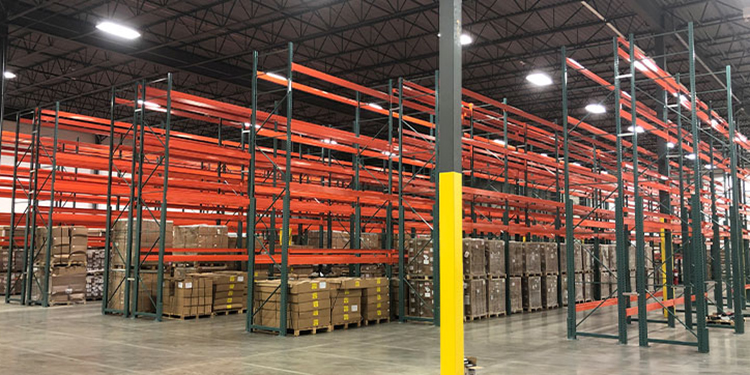
For selective rack—where operators can access every pallet position directly from the aisle—loading should start at the middle of the bottom row, then work outward and upward. Operators should put the heaviest product on the lower levels near the center, then move toward the ends and the top as loading continues.
“Ideally, the core best practice is to load racks from the ground level up, and unload racks in reverse,” noted Jonathan Hirst, Vice President and General Manager at North American Storage Equipment Company (NASECO). The company is a member of RMI.
“It’s basic physics. Loading this way keeps the center of mass low,” he continued. “Additionally, heavy, dense loads belong on the bottom and tall, light, or bulky loads belong up high. It’s the same reasoning behind packing a moving truck or loading a boat. Only here it’s applied to a structure that holds tons of product several stories in the air.”
As for the FAQ’s recommendation to start at the middle of the row and work outward, Hirst is candid about how that plays out in practice.
“In reality, pallet putaway is frequently so randomized that the rack ‘honeycombs’ very quickly,” he said. “Inventory turns, pick sequences, and receiving schedules rarely let a facility fill a row of rack in a tidy, deliberate pattern. The center-out sequencing offers a helpful mental model, but the bottom-heavy, top-light hierarchy is the pallet rack loading best practice that consistently holds up.”
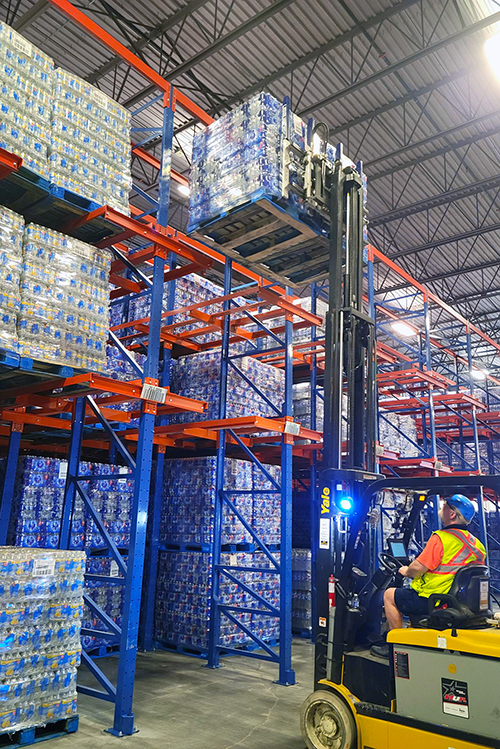
Drive-In Racks Play by Different Rules
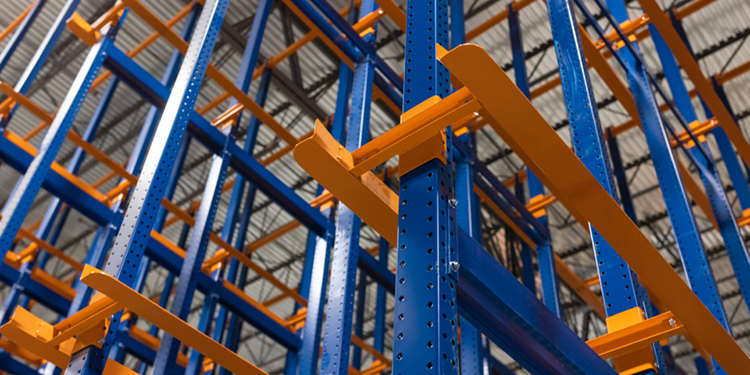
Unlike selective rack, loading best practices are different for drive-in rack. In these highly dense storage systems, pallets sit several deep and forklifts must enter and exit the system to load and unload pallets. That calls for a different—and far more rigid—loading sequence, said Hirst.
“With drive-in rack, loading starts at the ground level in the deepest position of the lane, then progresses upward and then forward. So ground level first, working back toward the aisle level by level,” he explained.
Unloading drive-in rack reverses that sequence. Operators pull the top level at the aisle first, then work down to the ground, before advancing deeper into the lane.
“You don’t want to be removing pallets from interim levels,” cautioned Hirst said. In a drive-in system, skipping around isn’t just inefficient. It can mean digging pallets out from underneath other loads, which can lead to product or rack damage.
The rule that carries through every system, drive-in or selective, is simple. “You always want the top loaded last and unloaded first, universally,” he said.

Match Load Placement to Pick Frequency
Beyond weight and shape, Hirst says load turnover frequency should drive placement just as much as the best practice loading sequence does.
“Store high-turnover products at levels under 12 feet, where the expectation of speed and frequency is highest,” he said. “Operators should reserve the top levels for slower-moving, bulkier items that will sit longer between touches.”
That recommendation can potentially conflict with the “top loaded last, unloaded first” rule, since operators don’t always access the top last in real-world operations. But Hirst says the trade-off is worth it.
“It’s far better, if you have to access something frequently, to store it at the lower level because it reduces damage,” he said. “Every trip to a high level with a forklift mast extended gives an operator another chance to clip a beam or drop a pallet corner. Storing fast-moving inventory low keeps the riskiest, most frequent movements closer to the ground.”
Why Pallet Rack Loading Best Practices Matter
Following these recommended pallet rack loading best practices where possible can significantly improve operational safety. That’s because they lower the center of mass, reduce how often operators lift fast-moving product to high levels, and keep damage-prone maneuvers closer to the ground.
For more information on pallet rack loading best practices and other rack design and use topics, visit RMI’s full FAQ library and related standards.