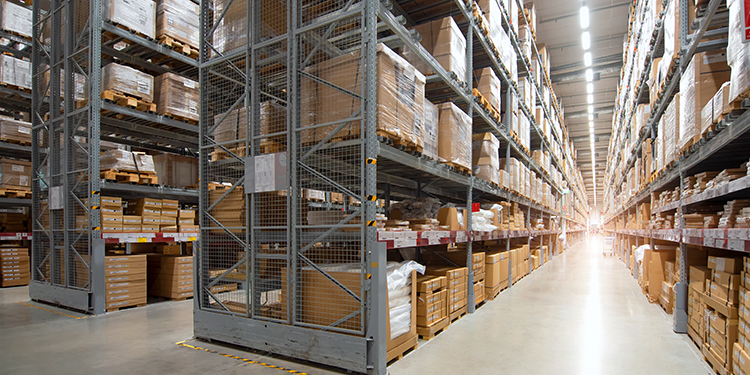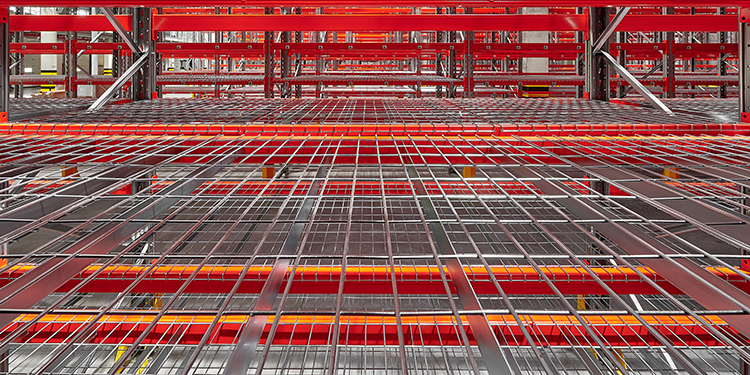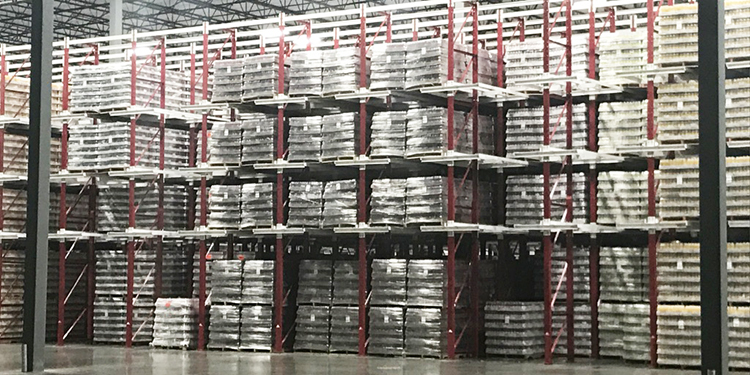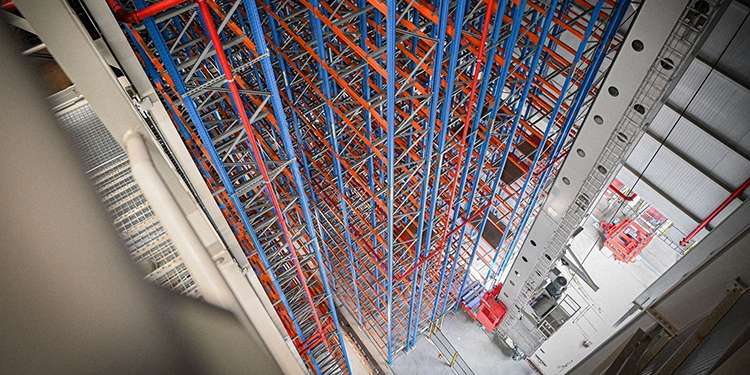
Automated storage and retrieval systems (AS/RS) continue to gain momentum as companies push for higher throughput, labor efficiency, and denser storage footprints. But unlike conventional pallet rack, AS/RS rack automation structures must hold inventory and support the constant movement of high-precision automation equipment. That requires an evaluation of every structural decision—from footplate placement to column size to load combinations—to ensure long-term performance.
“A mistake in planning or design often cannot be easily corrected later,” said Ryan Wachsmuth, SE Regional Sales Manager at Steel King Industries. The company is a member of the Rack Manufacturers Institute (RMI). He explained that the most successful AS/RS projects start long before steel arrives on-site. The following details key safety, installation, and configuration considerations for AS/RS racking to ensure long-term performance and operational efficiency.
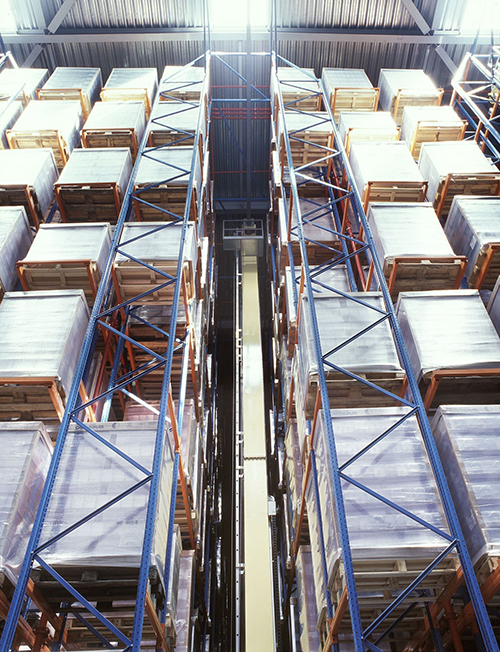
Early Stakeholder Engagement Reduces Unknown Project Risks
One of the first priorities, Wachsmuth said, is to gain buy-in from all stakeholders. Overlooking stakeholder input early almost always creates expensive operational challenges later, he noted.
“Anytime I have conversations with somebody who’s looking to make a change, add to, or design racking around AS/RS, I urge them to get all parties involved,” he said. “That means from the CFO and CEO down to the people who will be interacting with the automation.”
While automation projects are often initiated at the executive level, Wachsmuth warned that excluding operations personnel introduces unnecessary and preventable risk. Workers on the floor understand pain points, bottlenecks, and safety hazards that may not appear on executive dashboards. Their input helps ensure the AS/RS’s design matches real-world conditions rather than assumptions.
In addition to internal feedback, companies should proactively involve safety teams, insurance carriers, building officials, and the automation provider. Each group brings specialized insight, from fire protection requirements to seismic criteria to operator safety planning. Wachsmuth cautioned that companies sometimes avoid looping in insurers or their local regulatory jurisdiction too early, fearing added complexity.
“It doesn’t hurt to get your insurance company involved,” he said. “They might see something because another business had an incident. People think, ‘That could never happen to us.’ Well, it could never happen to them—and it did.”
The goal is not to slow down the project, but to eliminate blind spots before they become costly change orders. The earlier these parties participate, the faster final approvals and commissioning typically go. Waiting until late-stage planning can result in costly redesigns of racks and equipment or even building modifications.
Structural Engineering for Rack Automation Must Extend Far Beyond Load Capacity
Unlike selective pallet rack, AS/RS structures must withstand dynamic forces from automated equipment operating 24/7, often at heights of 40 feet or more. Every design must account for static pallet loads, seismic conditions, and other external forces, such as heavy snow accumulation if the system is part of a rack-supported building. Wachsmuth emphasized that proper structural design goes well beyond basic load tables.
“The rack design should match your seismic area and how you envision it with loads, weights—everything,” he noted. “Down-aisle, cross-aisle, snow loads—those factors all matter.”
Automation also magnifies the consequences of even minor rack damage. A bent upright on a manually operated rack might go unnoticed until an inspection. However, automated equipment requires millimeter-level precision to operate safely. Wachsmuth has seen operations justify skipping protective products to save upfront cost, only to pay more later.
“You might think it’s an added $30,000 cost, but over a few years you could spend $75,000 in repairs,” he said. Therefore, rack protection and inspection programs are essential budget items for AS/RS installations.
Structural engineering must also anticipate future changes, Wachsmuth added.
“If load profiles or SKU mixes evolve, will the rack continue to perform as designed? AS/RS retrofits are extremely difficult to make post-installation,” he cautioned. “A rack designed only for current conditions risks becoming a costly bottleneck if business needs shift.”
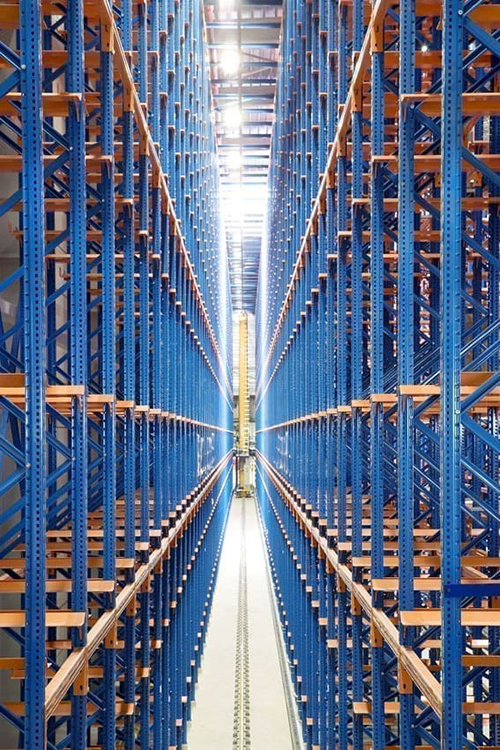
Floor Engineering Is Critical to System Longevity
While companies often focus on the rack structure itself, the concrete slab beneath it is equally critical to system performance. AS/RS columns concentrate thousands of pounds of force into a small footprint. If the slab was originally poured for forklift traffic or conventional rack, it may not have sufficient thickness or reinforcement to support automation.
“You’ve got thousands of pounds going down on a concentrated point of that floor,” Wachsmuth said. “If you just put up racking without knowing the floor, you might crush your way through.”
Proper floor assessment often requires core drilling, sub-slab soil testing, and a detailed loading diagram. A four-inch slab may work for hand pallet jacks—but not for a 50-foot structure containing millions of pounds of product.
If the slab is insufficient, reinforcement is possible, he added. “But it can involve excavation, doweling, or installing concrete piers—work that quickly adds cost and time,” said Wachsmuth.
Because floor repairs are disruptive once a system is operating, companies should validate floor capacity early in the planning phase. Many owners assume that if the building has successfully supported manual operations for years, it will automatically support automation. That assumption can lead to slab failures, rack settlement, and long-term performance issues that are far more expensive to correct retroactively.
Professional Rack Automation Installation Is Not Optional
AS/RS rack installation requires millimeter accuracy and experience with automation-specific tolerances. Unlike conventional pallet rack, where shims and adjustments post-installation can correct minor variations, it’s critical to get AS/RS installation right the first time. Wachsmuth has observed significant differences in contractor skill.
“Not every installation crew off the street is capable of installing AS/RS racking,” he said. “The ones that do are highly specialized. They cost more but deliver the highest quality work.”
Improper installation can lead to misalignment, binding of automation shuttles or cranes, and long-term maintenance issues that may not surface until go-live. Wachsmuth has personally seen installations with reversed beams and incorrectly placed components. These situations create unsafe conditions and require time-consuming and costly tear-out and rework.
Quality installers will also inspect the slab for deviation before installation begins. Wachsmuth explained that experienced crews use precision lasers to determine optimal shim placement, for example. A single low point in the slab can create a misalignment that propagates upward through the structure. Experienced installation crews will know how to compensate for floor swales, he added.
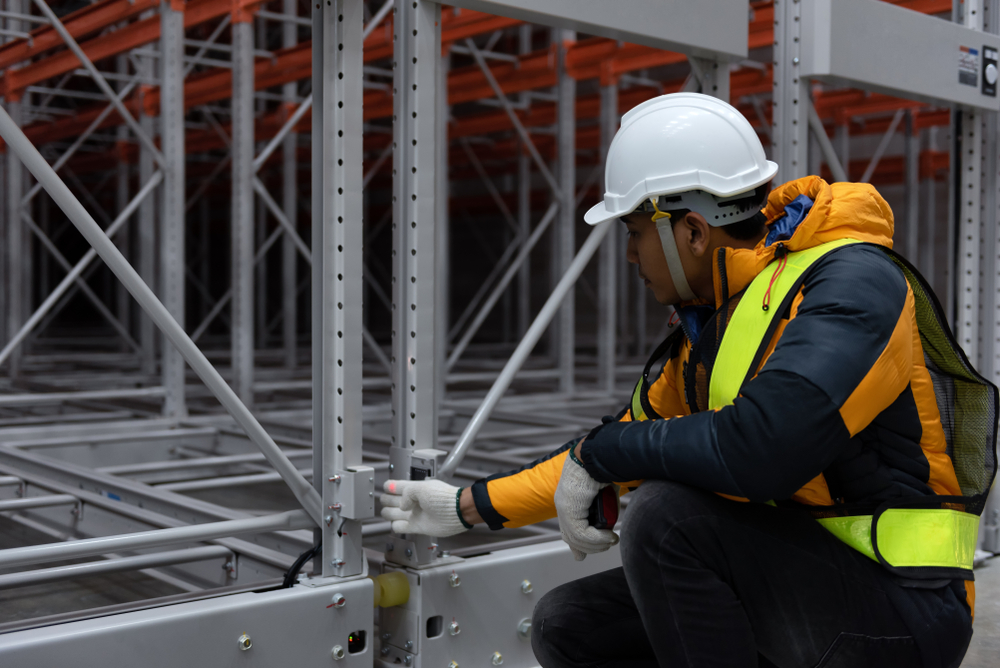
Rack Configuration Must Support Both Current and Future Operations
A common pitfall in AS/RS planning is designing the rack structure to fit an existing layout rather than stepping back and reevaluating whether the current flow makes sense. Wachsmuth encourages companies to treat AS/RS design as a fresh start.
“Are you just designing the system to match the way things are because it’s always worked that way?” he asked. “Introducing automation like an AS/RS gives you a blank canvas to reconsider your operational flow and determine if it still makes sense.”
Design decisions should account for inbound receiving, stock keeping unit (SKU) velocity, order profiles, and future business plans—not just current workflow. For example, placing AS/RS in an inconvenient location may require more internal transportation, adding unnecessary labor and equipment costs. Similarly, a facility planning major growth within five years may benefit from reserving adjacent real estate for future AS/RS expansion modules rather than boxing the system into a corner, Wachsmuth added.
Finally, once installed, AS/RS systems are difficult and costly to move. Wachsmuth stressed that companies must think ahead.
“Once it’s up, you don’t want to take it down. It will cost more than you paid for it,” he said. “Designing for flexibility on the front end prevents expensive operational limitations in the future.”
Safety Procedures Must Be Developed Before Go-Live
Even the most structurally sound AS/RS installation requires well-defined operational safety processes. Companies must establish clear protocols for situations such as a pallet falling, a shuttle malfunctioning, or a rack component being damaged. Wachsmuth compares this to a fire drill.
“Employees must know exactly what to do before an incident occurs, not after,” he advised. “You don’t just work around a fallen pallet until someone cleans it up.”
Every procedure should establish responsibility, escalation paths, and equipment lockout protocols. Automation may give the impression of a hands-off process, but human intervention will always be necessary in exception scenarios. Training operators on not only what to do—but also why following established procedures is essential—improves compliance and reduces the risk of unsafe improvisation.
Safety culture must also include rack inspections. Damage that goes unnoticed in a manual warehouse can become catastrophic in an automated system.
“A proactive safety and inspection framework is far easier to build before the system goes live than to enforce once operations are underway,” noted Wachsmuth.
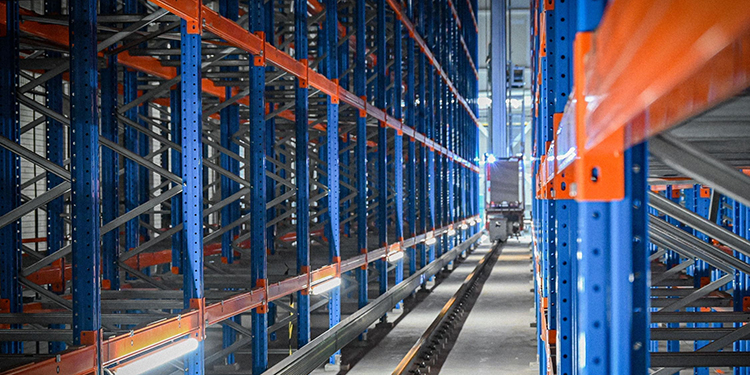
Learn More About AS/RS and Rack Automation
RMI advises facility owners, engineers, and integrators to work with qualified manufacturers who understand the complexities of integrating pallet rack and automation. All designs should follow ANSI MH16.1 and other RMI standards to ensure compliance with structural and operational requirements. For more information, consult “Considerations for the Planning and Use of Industrial Steel Storage Racks.” Additionally, RMI members are available for guidance, insights, and recommendations. For more information, visit mhi.org/rmi.