Rack stability is one of the most critical and often misunderstood factors in warehouse safety. While pallet rack systems may appear simple at a glance, their performance depends on a highly engineered balance of efficiency, load capacity, and structural behavior.
Unlike more robust structures, rack engineers design these systems to maximize storage capacity while minimizing material use. That means, upon deployment, racks operate closer to their deemed safe structural limits. This reality makes rack stability not just a design consideration, but an ongoing operational priority that depends on every structural component functioning exactly as intended.
According to Ronald D. Ziemian, Ph.D., P.E., Professor in the Department of Civil and Environmental Engineering at Bucknell University and a technical consultant to the Rack Manufacturers Institute (RMI), rack systems are uniquely sensitive to stability concerns compared to traditional structures—like buildings, for example. Ziemian is a specialist on stability who serves as the editor of the Guide to Stability Design Criteria for Metal Structures. That sensitivity increases the importance of proper design, correct installation, and consistent maintenance practices in order to preserve rack stability over time.
What Is Rack Stability?
At its core, rack stability refers to a system’s ability to support loads safely without experiencing buckling or collapse. In structural engineering, stability closely ties to how members behave under compression—particularly their tendency to deform or buckle under load. While this concept applies to all steel structures, it becomes far more critical in rack systems as a consequence of their slender, efficient design.
“When we talk about stability, we’re really talking about preventing the structure and its components from buckling,” Ziemian explained. “Because rack components are often intentionally designed to use the least amount of material necessary, they are inherently more sensitive to imperfections, damage, and changes in loading conditions. The skinnier or more slender something is, the more likely it is to buckle.”
That efficiency is what makes modern storage possible. However, it also means that maintaining rack stability requires careful attention at every stage of a system’s lifecycle.
Why Racks Are More Sensitive Than Buildings
One of the defining differences between rack systems and traditional buildings is the concept of redundancy. In the design of most building structures, the complete system often provides for multiple load paths. This means that if one component fails, the load can redistribute through alternate paths. This built-in redundancy provides a level of forgiveness that helps prevent localized damage from becoming catastrophic.
Rack systems, by contrast, often lack these alternative load paths. Load forces transfer in a direct path—from beams to uprights and down to the floor—without the same level of backup support.
“In racks there aren’t many, if any, alternative load paths,” noted Ziemian. “If you lose a column, there is often no possibility that the load can go anywhere else.”
This lack of redundancy makes rack stability highly dependent on every component performing as designed. When a failure does occur, it can escalate quickly into a progressive collapse.
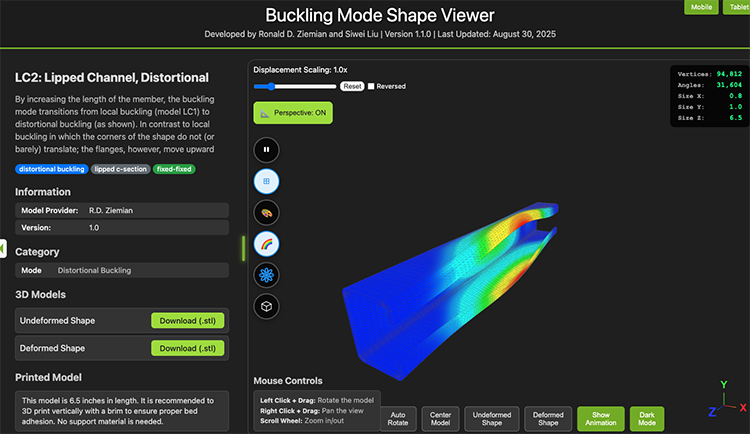
“One member buckles, then another, and then there’s a cascade of failures,” he explained. To help rack owners and users more easily visualize this buckling behavior, Ziemian published 3D structural instability models online.
He notes that this complexity increases further because, unlike buildings that use standard I-shaped steel sections, racks are usually built from perforated lipped C-shaped sections, which can fail in several different ways by buckling.
Rack Stability Depends on Every Component
A critical takeaway for facility managers is that no single component governs rack stability. Rather, it results from constructing a fully integrated system in which each element contributes to overall performance. While it may appear that uprights serve as a rack system’s primary structural members, their ability to carry load depends heavily on the support provided by other components.
The Role of Bracing in Rack Stability
Bracing, for example, plays a crucial role in preventing buckling, even though it may not appear to be doing much under normal conditions.
As Ziemian explained, “Bracing limits displacements at points along the column length and, as a result of effectively making the column length shorter, allows the system to carry significantly more load than it otherwise could. If bracing is damaged, removed, or improperly installed, it significantly reduces the rack’s ability to support these loads.”

How Anchors Affect Rack Stability
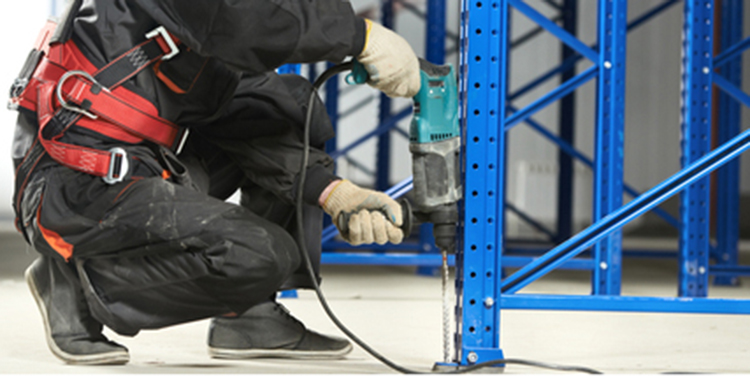
Anchors are another commonly overlooked component that directly affect rack stability. Although they appear to just be holding the rack in place, they also contribute to the structural performance of the system by providing rotational restraint that results in an increase in stiffness at the base of the uprights.
“Engineers actually utilize the additional stiffness provided by those anchored baseplates to ensure the uprights achieve their designed capacity,” Ziemian observed. “Any modification or neglect of anchors can therefore compromise the system in ways that are not immediately visible. A change from one to two anchor bolts—with one bolt on each side of the column in the down-aisle direction—is key to ensuring this additional stiffness. Further, a two-anchor bolt detail may also be vital in preventing a single column incident from becoming a progressive sidesway row collapse incident.”
In some rack configurations, system interconnectivity also contributes to stability. Certain designs rely on adjacent rack sections for support, meaning that one part of the system is effectively “leaning” on another. This interconnected behavior further underscores the point that no component or section can be treated in isolation.
Learn More About Rack Design
RMI members are available to help advise warehousing and distribution operations on rack design and use. As the industry’s leading suppliers of industrial steel storage racks and related structural systems, they supply industrial rack solutions worldwide and in virtually every major manufacturing and distribution sector.
Further, RMI offers a variety of rack safety resources and publications. These include videos, technical guidance, and educational materials. Each helps end users better understand safe rack design, installation, inspection, and operation. Find more online at mhi.org/rmi.