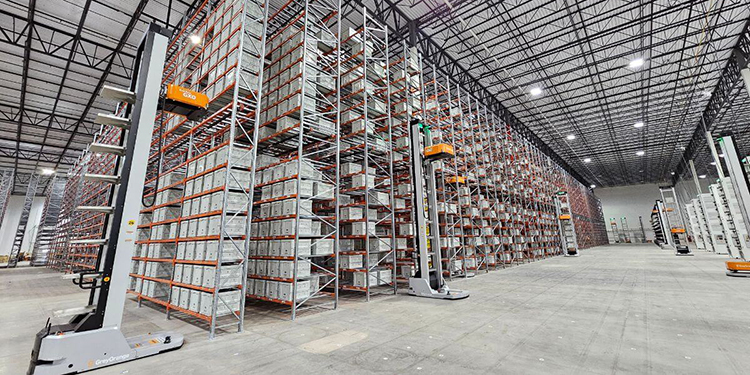
Mobile robotic automation is reshaping the warehouse. Automated guided vehicles (AGVs) and autonomous mobile robots (AMRs) are now common in distribution centers, fulfillment operations, and manufacturing facilities. But integrating these technologies isn’t just about software and navigation. It starts with the right racking system.
“AMRs and AGVs are transforming warehouse operations, but racking systems must keep pace,” said Sebastian Marshall, U.S. Product Manager at AR Racking. The company is a member of the Rack Manufacturers Institute (RMI). “Racks must be precise, durable, and robot-compatible from day one. Designs that ignore robotics increase risk, limit performance, and cost more over time.”
Understanding the Needs of Mobile Robotic Automation
AGVs typically follow fixed paths guided by magnetic tape, wire, or embedded markers. AMRs, in contrast, navigate freely using sensors, maps, and algorithms. Both technologies require precision—but in different ways, noted Marshall.
“AGVs depend on predictable layouts with consistent aisle widths and fixed pallet positions,” he observed. “AMRs demand a flexible, obstruction-free environment. That means racking systems must be straight, stable, and consistent at every level, from upright placement to beam deflection limits.”
Even slight structural inconsistencies can disrupt navigation, impact throughput, or increase risk. That’s why racks supporting mobile robotic automation are engineered to tighter tolerances.
“Racks used with AMRs and AGVs also undergo more detailed layout planning than those in conventional facilities,” added Marshall.
Built to Align with Robots, Not Just Pallets
Mobile robotic automation requires rack systems that are structurally precise and robust at floor level. Most robotic contact occurs at the rack base. Without the right reinforcements, repetitive impacts can degrade both the racking and the robot over time.
To mitigate this, systems are designed with reinforced footplates, column protectors, and low-level guards, Marshall said.
“These features absorb impact, protect structural elements, and reduce downtime. Beam heights and pallet position configurations must also match robot travel paths, sensor lines, and loading heights,” he noted.
Racking geometry also accounts for vehicle turning radii and acceleration zones. This is especially important for AMRs that navigate dynamically.
“Racks must be precisely aligned at the millimeter level,” Marshall continued. “Both AMRs and AGVs rely on minute precision when navigating and positioning loads. Even minor misalignments or deflections in rack structures can cause significant issues for these systems.”
Supporting Robotic Navigation and System Reliability
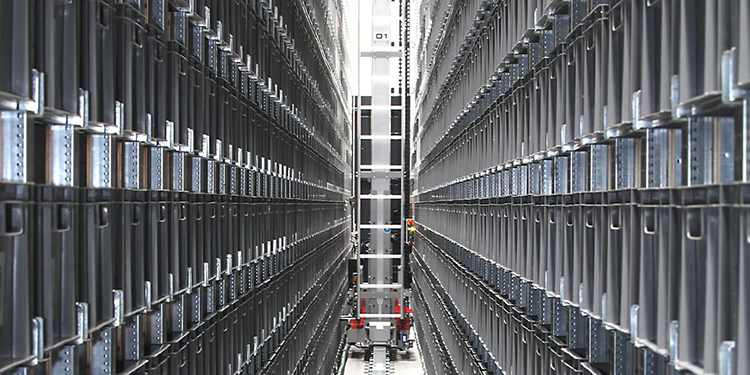
Sensors, cameras, and scanning systems are central to successful mobile robotic automation navigation. Misplaced reflectors or poor rack surface finishes can interfere with robot vision or scanner performance.
“Racking designed for AGVs and AMRs should use matte finishes to prevent light reflection,” advised Marshall. “It should also incorporate standardized mounting locations for QR codes, RFID tags, and other markers.”
In some facilities, the rack frame integrates sensor mounting brackets and cable routing. This supports auxiliary systems like lights, scanners, or safety beacons.
“In every case, the goal is consistent recognition,” he continued. “Robots must see and read every marker the same way, every time.”
Floor Conditions Matter
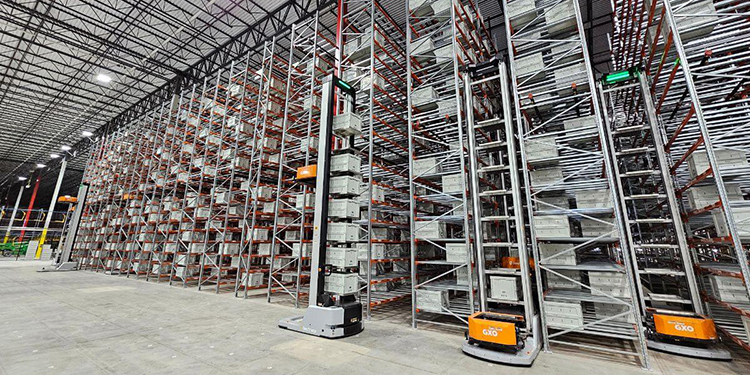
Rack design can’t ignore the floor. Likewise, mobile robotic automation depends on flat, level surfaces. Both AGVs and AMRs are vulnerable to misalignment from floor irregularities.
“If the floor is out of spec, robots may drift off course or struggle with load placement,” Marshall noted. “If a floor is not perfectly level, shims or adjustable footplates help maintain rack alignment. These small adjustments make a big difference in long-term robotic performance.”
The Value of Early Coordination
A successful mobile robotic automation deployment also depends on early collaboration. Marshall encouraged facility owners to connect their AMR or AGV supplier with their rack engineer at the start of a project.
“Design coordination includes aisle mapping, pallet placement strategies, sensor layout, and clearance modeling,” he explained. “Simulations and 3D layout tools can validate designs before the installation of any. This saves time and prevents rework.”
Many RMI member companies also offer post-installation validation. That includes checking structural tolerances, calibrating robot routes, and verifying that racks perform as expected under dynamic robotic loads.
Get More Details About Integrating AMRs and AGVs with Rack
Before deploying mobile robotic automation into a rack system, consult with a qualified manufacturer who understands the nuances of these applications. All designs should follow ANSI MH16.1 and other RMI standards to ensure compliance with structural and operational requirements. RMI members can provide guidance, insights, and recommendations into such deployments. For more information, visit mhi.org/rmi.