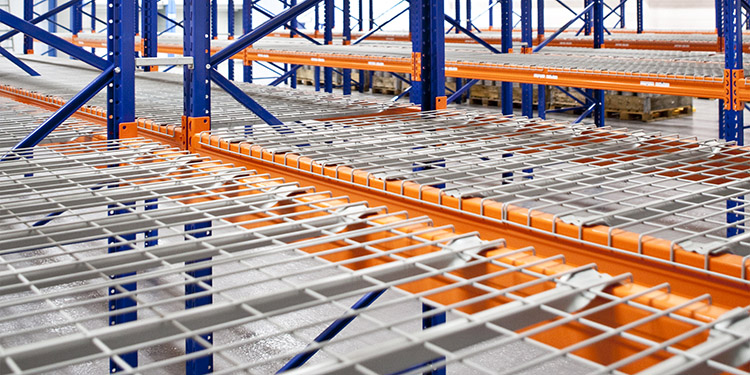
As storage systems evolve, even the components that seem simplest—like rack decking—play a critical role in overall safety and performance. To address this, the Rack Manufacturers Institute (RMI) has aligned its R-Mark® Certification for rack decking program with the updated ANSI MH26.2 storage rack decking standard.
Unlike rack systems, which are engineered as complete structures, storage rack decking occupies a unique position in the R-Mark ecosystem. The certification reflects that difference, while still reinforcing consistent manufacturing, testing, and performance expectations.
“Think of a storage rack as a giant erector set,” explained Patrick Davison, Director of Standards at MHI. “There are various ways you can assemble rack. With storage rack decking, that’s not really the case. It’s simpler in application, but it still has to perform reliably.”
How R-Mark Certification for Rack Decking Is Different
One of the most important distinctions is that R-Mark certification for rack decking applies to the product itself. Conversely, R-Mark certifications for industrial storage rack or cantilever storage rack apply to the full rack system in a specific installation.
“A rack decking manufacturer would fall under the R-Mark certified manufacturer designation,” said Michael Russo, Product Development Engineer at RMI member Ohio Gratings. “They’re not providing certification for a system or a specific installation.”
Jarno Palo, National Account Manager at RMI member Nashville Wire, emphasized that difference as well.
“The rack decking R-Mark is a product-specific certification,” Palo said. “Whereas other R-Marks apply to each rack system specifically.”
This makes decking the exception within the R-Mark framework. While most rack components cannot be certified independently, decking that meets the requirements of ANSI MH26.2 can qualify under the program.
The Role of ANSI MH26.2
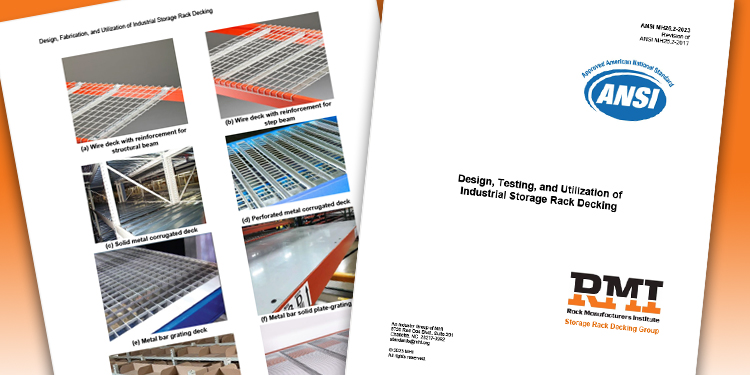
The ANSI MH26.2 standard forms the backbone of the R-Mark certification for storage rack decking, defining product testing and evaluation.
“MH26.2 is essential because it describes the load test procedure and how results are interpreted,” Palo explained. “Without it, producers would determine capacity using whatever method they want, and the results wouldn’t be comparable.”
Russo added that the standard specifically establishes the uniformly distributed load (UDL) testing requirement.
“The ANSI MH26.2 standard lays the groundwork for the uniformly distributed load test,” he said. “R-Mark certification requires that rack decking testing to be done in accordance with that standard.”
Recent updates to MH26.2 have expanded the scope of decking covered. Originally focused on welded wire decking, the standard now includes a wider range of materials. These include corrugated metal deck, bar grating, plate grates, composite wood products, and perforated steel.
What Manufacturers Must Demonstrate
Although the process is simpler than for full rack systems, R-Mark certification for rack decking still requires manufacturers to demonstrate consistent quality and compliance.
“Companies still have to go through third-party testing and provide documentation showing their procurement processes, internal quality systems, and welding compliance where applicable,” Davison said.
Palo noted that manufacturers must also prove repeatability and control.
“We have to demonstrate that we control the quality and tolerances of raw materials, so the result is consistent,” he said. “We also have to show we can design and build products that satisfy the standard.”
Decking manufacturers are not required, however, to meet the Qualified Engineering Delegate (QED) requirement that applies to rack system certification. However, all other documentation and testing requirements remain in place.

Why Load Conditions Matter More Than Capacity Alone
While decking may carry a specific load capacity rating, real-world performance depends heavily on the application of that load.
“Decking calculations are different than those involved in engineering a rack system,” Davison said. “But that doesn’t mean loading conditions don’t matter. They absolutely do.”
Russo emphasized that point, noting that users often misunderstand how loads interact with decking.
“Users may only consider the overall load capacity and assume it’s evenly distributed,” he said. “But some pallets produce line loads or point loads, which don’t uniformly load the decking surface.”
Palo added that uniformly distributed loads represent most scenarios—but not all.
“Designing decking for a uniformly distributed load covers between 80 to 90 percent of applications,” he said. “But customers need to think about point or concentrated load scenarios and communicate those up front.”
These nuances can significantly impact performance. A heavy load concentrated on a small footprint can create far greater stress than the same weight distributed evenly.
“Even if a storage rack decking’s rating is for a certain capacity, the user has to take the characteristics of the unit load into account,” Davison said.
Common Misunderstandings—and Risks
One of the most common issues is assuming that decking capacity aligns directly with beam capacity.
“Often, users assume the load is even across the surface,” Russo said. “But that’s not always the case, and that can create safety risks.”
Palo pointed to another frequent misunderstanding: how capacity ratings are defined.
“Some products claim a capacity only if the load rests on the beams,” he said. “But MH26.2 and R-Mark testing require that capacity to be independent of the beams. That’s a big difference—and a major liability if misunderstood.”
Damaged pallets or inconsistent load bases can further complicate performance. This underscores the importance of proper inspection and load management.
Why R-Mark Certification for Rack Decking Matters for Buyers
Despite its narrower scope, R-Mark certification for rack decking provides meaningful value for buyers evaluating these products.
“It shows that the product meets the minimum requirements of the MH26.2 standard,” Russo said.
Palo agreed, summarizing the benefit succinctly: “Quality assurance, consistency, and buyer confidence—the R-Mark ensures all of the above.”
R-Mark certification can streamline approval processes and provide an added layer of quality assurance. It also helps ensure that storage rack decking performs as intended under real-world conditions.
How to Find an R-Mark Certified Rack Decking Manufacturer
RMI maintains an updated list of R-Mark certified rack decking manufacturers on its website. Buyers can confirm a company’s status, review certification details, and request information about certified systems. For more details, visit mhi.org/rmi.