In today’s distribution and manufacturing environments, companies often rely on elevated structures to maximize space and support operations. Yet one of the most persistent—and potentially costly—sources of confusion in facility design comes from the terminology used to describe these structures. Indeed, many professionals still use the terms “mezzanines” and “industrial work platforms” interchangeably. That, however, would be a mistake.
“To the untrained eye, these two types of structures often look nearly identical,” noted Chris Pahls, Product Manager at Steel King Industries. The company is a member of both the Rack Manufacturers Institute (RMI) and the Storage Manufacturers Association (SMA). “In actuality, the differences between industrial work platforms and mezzanines are pretty large, particularly when you get into design and permitting.”
Today, widespread use of industrial work platforms in distribution and manufacturing has made those distinctions far more important. When teams mislabel a structure, they risk incorrect design assumptions, permitting delays, and unnecessary costs.
Pahls emphasized the importance of aligning terminology early—before teams finalize designs and begin the approval process. “You don’t want to get too far down the road with a misconception,” he said.
Comparing and Contrasting Mezzanines and Industrial Work Platforms
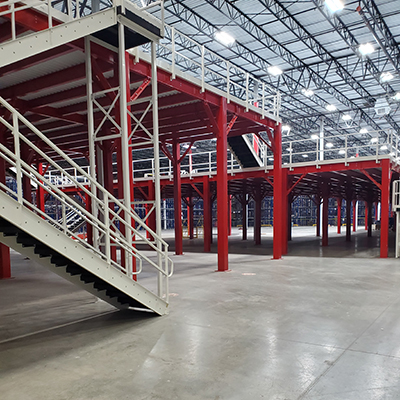 At a glance, both mezzanines and industrial work platforms create additional usable space within a facility by taking advantage of overhead space. Facilities use them both for a variety of purposes, including for inventory storage and picking, to support process flows, to access equipment, for maintenance, and more. However, those similarities often lead to confusion. In actuality, classification—not appearance—defines how each structure functions, continued Pahls.
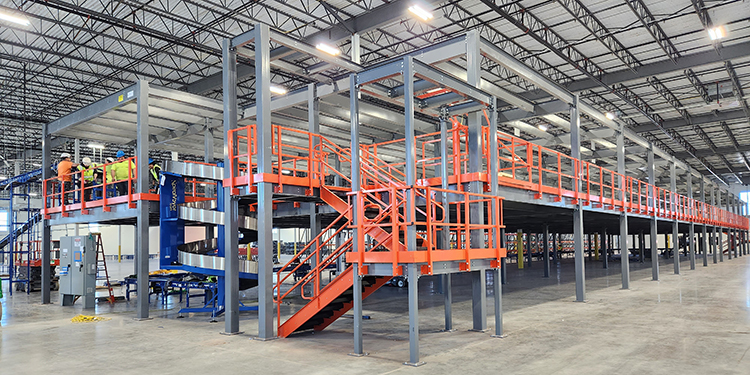
“A mezzanine is typically part of the building’s structure, integrated into the original design plans and construction. The building’s designers tie it into the facility’s column system and plan for long-term permanence,” he said. “In contrast, industrial work platforms are freestanding structures that are frequently retrofit projects tailored to meet specific operational needs. They are considered equipment that’s installed inside an existing building and anchored to the floor.”
Because mezzanines are a physical part of a building, they often rest on permanent pillars or columns and feature poured concrete floors. That added weight increases structural demands, which requires larger members and more robust support systems.
“Concrete mezzanines weigh a lot more and require heavier members. Conversely, installers assemble industrial work platforms with bolted connections and decking or other removable flooring panels,” noted Pahls. “That allows an operation to modify, expand, or relocate the structure as operations evolve. Mezzanines, by comparison, cost significantly more while offering less flexibility once constructed.”
This distinction—structure versus equipment—directly influences design decisions, code compliance, project cost, and long-term operational versatility.
Code Compliance Differences
Classification becomes especially critical during code compliance and permitting. The label assigned to a structure will shape how the International Building Code (IBC) and the Authority Having Jurisdiction (AHJ) evaluate it.
Because mezzanines are building structures, they must comply with stricter requirements for engineering, construction, accessibility, egress, and fire protection. In contrast, building inspectors typically evaluate industrial work platforms—which typically support controlled industrial environments with limited access—based on their role within an operation.
Misclassifying a structure can result in unexpected jurisdictional requirements late in the process, cautioned Pahls. He recalled a project where a design team submitted a structure labeled as a mezzanine for permitting when, in fact, it was an industrial work platform.
“Late in the approval process, the AHJ required the installation of an elevator to meet accessibility standards,” he said. “That added significant cost and complexity, all because they used the wrong term on the engineering drawings.”
Standards That Define Industrial Work Platforms
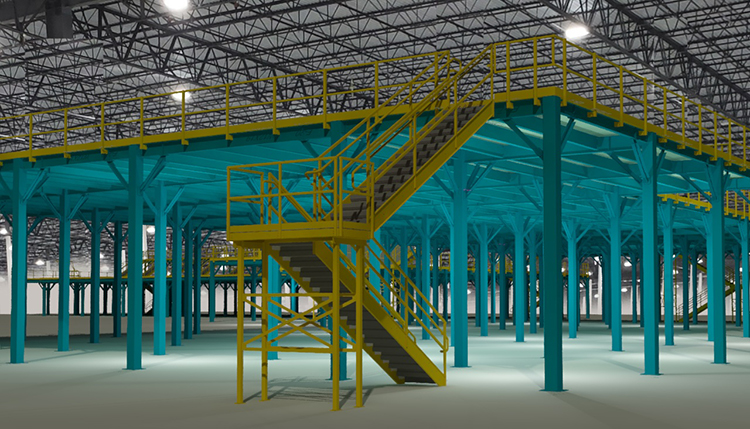
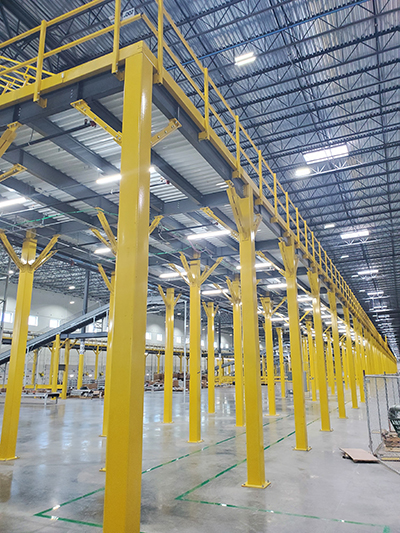 To bring consistency to industrial work platform design and safety, RMI and SMA collaborated to develop American National Standards Institute (ANSI) standards. They include:
- ANSI MH28.3 defines the structural design framework for industrial work platforms. It covers loading requirements, seismic considerations, and system integrity.
- ANSI MH32.1 addresses access and fall protection on industrial work platforms. This includes stairs, ladders, and guardrail systems.
Together, these standards give engineers and operators a clear framework for designing safe, application-specific industrial work platforms. For example, standard guardrails must reach a minimum height of 42 inches and withstand a 200-pound concentrated load on the top rail, along with additional requirements for intermediate rails. In industrial environments, designers may allow larger openings than in public spaces, reflecting the controlled nature of access.
Further, engineers design industrial work platforms around their intended use. For example, a platform that supports storage may require higher live loads, while a maintenance platform may require less capacity. This application-driven approach allows teams to optimize material use and control costs.
Have More Questions About Industrial Work Platforms?
RMI members are available to help advise warehousing and distribution operations on industrial work platform design and use. As the industry’s leading suppliers of industrial steel storage racks and related structural systems, they supply solutions worldwide and in virtually every major manufacturing and distribution sector.
SMA members are the Industry’s leading suppliers of industrial storage equipment. They supply storage solutions worldwide and in virtually every major manufacturing and distribution sector. Industrial storage equipment includes steel shelving, industrial work platforms, work and assembly stations, modular drawer equipment, clothing storage lockers, movable base storage equipment, storage containers and directly related equipment.
Connect with the Rack Manufacturers Institute’s (RMI) or the Storage Manufacturers Association (SMA).